
(UPDATE: It seems Wilders' film has appeared. I'll have a look at it later).
(UPDATE OF UPDATE: LiveLeak removed the film because of threats. Still available though at http://www.fok.nl/mirror/fitna.html. Dutch version, at least. Otherwise check google videos.)
(UPDATE 2: I just saw Wilders' overhyped videoclip. First impressions: not unskilfully done, but the classical music is too soft. Would have needed something more ominous and martial, like Holst's "Mars, the Bringer of War". As it is, it makes me want to go to sleep. The film itself consists of gory footage of Islamists atrocities and footage of extremist preachers and politicians in the first half, coupled with manipulatively translated sections of the Quran - I seriously doubt the Quran has a word for "terrorize" with exactly the same implications we see in the word. In the second half, it switches to scare-mongering about Islamic mass immigrations, photographs of mosques sprouting up in the Netherlands, niqaab-clad women pushing prams, etc. The start is pretty menacing, but the film loses steam very quickly. There's no comment or anything, so as a whole the film becomes overly disjointed and transparantly propagandistic (letting the imagery "speak for itself"). As the film didn't make me hate muslims, I guess it's a failure. Wilders deserves special points for confusing Theo van Gogh-killer Mohammed Bouyeri with Moroccan-Dutch rap talent Salah Edin. Also, he isn't really tearing a page from the Quran, but a page from a phone book while the screen fades to black! Boo hoo! What a coward!)
Michael Moynihan at Reason magazine has a good piece (good, that is, aside from mentioning the words "thoughtful" and "Christopher Hitchens" in the same sentence) on the Geert Wilders controversy in the Netherlands at the moment.
But the article itself is unfortunately another sign of Holland's troubles making it's way into the international press. We used to be famous abroad for our dikes and our tulips and linguistic abilities. Now we are getting famous for islamic extremists murdering filmmakers and empty-headed "Mohammed was a pedo" anti-islamic discourse from what I guess used to be our intelligentsia. Wilders, at heart, is a windbag and a blowhard of little consequence. One who relentlessly focuses on one single issue without any underlying greater vision on Dutch society - which distinguishes him from other fierce critics of Islam such as the late Pim Fortuyn and Theo van Gogh who stood (however incoherently at times) for the libertarian streak in Dutch political history. Wilders, by contrast, is a relentless authoritarian, whose self-serving rumblings on "freedom of speech" when his own speech is concerned contrast sharply with his quickness for calling for bans on speech he doesn't like.
In a normal society, he would be regarded as the village idiot he is, and would have an assured the two seats in parliament normally alotted to cranks. However, thanks to the hysterical response from the Dutch political class to Wilders' planned (and eagerly awaited) fifteen minute anti-Islam videoclip Fitna, he has had just about all the attention the country could muster for the past month or so.
It's not only that the government is trembling in the face of the possible response among our own. It's also that we are involved - without much conviction - in the doomed nation-building project in Afghanistan. Now, the Dutch parliament will ask questions whenever a guy with a beard squints angrily at a Dutch soldier, and our Afghan enemies have not been slow to exploit this.
The result is that Wilders has been granted the political limelight, an electorally comfortable potential-victim role, and reasons to cry censorship, with little effort of his own. Thing with Wilders is, he's a coward at heart. He rejects offers by muslims to debate him. He has rejected an offer by the Dutch Muslim Broadcasting Company to screen his film (provided the film even exists). So he can continue to play the persecuted hero speaking truth to power. This again contrasts him with Pim Fortuyn and Theo van Gogh.
And in the end, Muslims will be right to be angry about Wilders' film if it indeed turns out to be the substance-free hate-fest I expect it to be. Just as they were right at being angry at the Danish cartoons portraying them as scimitar-waving terrorists. Let's make no bones about it: like the cartoons, the film will be designed to offend, to hurt feelings, and nothing more. Any blathering about provoking political discussion about the nature of Islam should be seen for the crap it really is. That's not what Wilders and his supporters are interested in. The whole point of the exercise is to taunt and to jeer and to offend - to vent the frustrations of twenty years of official multiculturalist ideology and it's wilful looking-away from the very real problems immigration brought with it, without actually facing and thinking about those problems.
Sometimes I think Christians should be a little more offended at the crap routinely - and without much protest - thrown at them. The difference is that Christianity in the Netherlands is historically so splintered that most Christian denominations (at least, those that are still vibrant) are used to being inwardly directed, living their own lives within Dutch society. Or being liberalized to death. This is why I am getting a grudging respect for Pope Benedict XVI. Conservative as he may be, he acts with conviction, in line with being at the head of the institution he leads. So I loved it when he snubbed the parvenu American emperor's emissaries, or when he did not sit up and roll over for the secularists at La Sapienza university. This despite with disagreeing with him on many religious matters. I would love to see a little more conviction among Christians participating in the political discussion in Western Europe. It's time to stop making excuses to the secularists for your very existence.
And the same goes for the muslims. The problem is that we are locked between weak-kneed, frightened calls for censorship on the one hand, and the extremely lowbrow nature of the discussion on immigration, secularism, the position of muslims in Western society, and so forth on the other hand. Much as I despise Wilders' views, I hope his film will not be censored and I hope it will be shown on Dutch television. And I would defend his freedom of speech, while holding my nose. Just as I would defend the freedom of a bad cartoonist drawing a dog wearing a turban, or God doing a blowjob, with similar distaste. Though I would rather live in a society where these would be seen for the puerile exercises they really are. Perhaps, the ultimate problem is really fear. A fear which sees no alternatives to dealing with religious minorities by the equivalent of scatological graffiti on the one hand, and denying any sort of problem on the other.
donderdag 27 maart 2008

donderdag 20 maart 2008
Simon Blackburn on respect and religion
British philosopher Simon Blackburn has a draft article up on issues of religion and respect from a puzzled atheist perspective. Some thoughtful comments by Chris of Mixing Memory here.
Blackburn starts off with recounting a dinner party where he was asked to join into some kind of religious observance, and refused. I sympathize to some extent with Blackburn here - he was right to refuse to take part in some kind of ceremony signifying something he doesn't believe in.
The rest of the article suffers, I think, from a much too stark dichotomy between what Blackburn calls "onto-theology" - religious beliefs thought as referring to something real, some kind of more or less detailed transcendent reality, and "expressive theology", which draws attention to the symbolic, the metaphorical, without necessarily referring to any transcendent reality. The problem of course is that assenting to some or more of the claims of "onto-theology" does not entail any rejection of the attention to religious practice as involving symbolism, myth, etc. in "expressive theology". And I think a lot of theologists are somewhere in between the two extremes that Blackburn sketches.
But the key quote, as mentioned by Chris at Mixing Memory, is this:
We can respect, in the minimal sense of tolerating, those who hold false beliefs. We can pass by on the other side. We need not be concerned to change them, and in a liberal society we do not seek to suppress them or silence them. But once we are convinced that a belief is false, or even just that it is irrational, we cannot respect in any thicker sense those who hold it--not on account of their holding it. We may respect them for all sorts of other qualities, but not that one. We would prefer them to change their minds. Or, if it is to our advantage that they have false beliefs, as in a game of poker, and we am poised to profit from them, we may be wickedly pleased that they are taken in. But that is not a symptom of special substantial respect, but quite the reverse. It is one up to us, and one down to them.
I think this is mistaken on a number of levels. First of all, the issue of "true" and "false" beliefs is problematic when dealing with religion - without this in any way entailing epistemic relativism. Elsewhere Blackburn writes that "In the
days of onto-theology, we knew what went on when someone claimed that ‘God exists’,
and we knew how to argue that there is not the slightest reason to believe it.". But I kind of doubt that. Because at least with Anselm and Thomas Aquinas, the existence of God becomes quite a different kind of existence than the existence of me or my table or my CD collection (Dawkins has expended great effort on avoiding to understand this). The notion of a necessarily existing being depends on a lot of philosophical framing which may be true of false but cannot surely known to be so (merely shown to be coherent, self-consistent or incoherent; useful and productive or the counterpart, etc.). The same goes for the, overt or hidden, metaphysical presuppositions on which the atheist seeks to challenge theism.
Then there is the notion that we cannot respect beliefs we hold to be false, but rather would seek to convince the holder of such beliefs to abandon them. That's highly doubtful. Much as I believe in certain religious propositions, I am aware and will always remain aware (in this life at least) that I may be mistaken. I believe theism is rationally defensible. So is atheism. And that's as far as it will go. The fallibilistic notion that whatever I believe to be true may eventually turn out to be mistaken for me entails the desire that if I turn out to be mistaken, someone will set me right, which of course necessitates that person holding different beliefs. No intellectual progress can be made without difference of opinion, and thus, with people holding false beliefs. Blackburn's notion that We would prefer them to change their minds illustrates that one should be careful what one should wish for.
That of course raises the question what it should take for a false belief to be respectable. Some kind of fallibilism, probably. Chris at Mixing Memory mentions the pragmatic consequences of the beliefs in question as well as intellectual integrity (as in actually studying the position one polemizes against - a good and venerable practice unfortunately frowned upon in Militant Atheist circles).
It is true that calls for blanket respect for this and that position can quickly turn into some kind of patronizing support of communalism, in which the validity of a position no longer matters. But there is a counterpart - a kind of descent into mindless jeering, without actually dealing in any way with the opposite position - which is just as bad and in a way just the other side of the coin. Some of the more extreme sides of the Militant Atheist spectrum occasionally descend into that (see Rational Response Squad and suchlike outfits). But I was thinking more about the non-approach to islamic minorities in Western Europe. In both cases - blanket respect and ill-informed attacks - actually facing the other position is studiously avoided.
donderdag 6 maart 2008
Reading Leonard Cohen's Scorpion
One book of poetry which I read frequently when I was about seventeen was Leonard Cohen's The Energy of Slaves. Rereading it now, it strikes me how unremittingly bleak most poems are. Back then, they must have fitted my mood just fine.
Leonard Cohen's The Energy of Slaves appeared in 1972, a year after his album, Songs of Love and Hate. Compared to his earlier albums, Songs of Love and Hate is much darker - where some of the work on Songs and Songs from a room are wistful and melancholical in an almost light-hearted manner, the tone on Songs of Love and Hate is much more serious, sometimes sardonic and mocking.
One poem from The Energy of Slaves which hit me immediately upon reading it the first time was Scorpion. Rereading it, it hit me again. The poem is a lyrical, defiant declaration of love of a woman to the scorpion - a brooding, solitary, but in some way heroic figure. The love which is sung in the poem is not an easy love: it is one which consumes and may ultimately destroy the singer. There is a tragic kind of mutual dependency here: the scorpion keeps his woman captive, in a way, in his own isolated sphere, at the same time, his woman is his window on a world he hates. There are many ways to read the poem: as the testimony of a love which lives despite everything: despite the dangers of the outside world, despite the hints of a very abusive relationship strewn throughout the poem, etc. It may also be a very rueful and puzzled comment by a male figure - the scorpion himself - on the love and loyalty shown to him despite his own tricks and his own malice.
The 1971 album, Songs of love and hate, starts off with one very much about both: Avalanche, a brooding, menacing anti-love song which may, perhaps, very well be read as the scorpion's answer to his beloved:
You who wish to conquer pain
You must learn what makes me kind
The crumbs of love that you offer me
are the crumbs I've left behind
Your pain is no credential here
It is the shadow of my wound
But, back to Scorpion:
O rare and perfect creature
who has made your nest in me
I'm on my way home to you
singing with the lips
you bloodied out of jealousy
I am your world
I am your wall
I'm on my way home to you - from where? Where has she been? The mention of bloodied lips and jealousy may hint at an act of violence between the two lovers - yet she decides to, despite all that, return to him. The last two lines here are wonderfully paradoxical: I am your world I am your wall - at the same time, the lover is the scorpion's window to the outside world, on the other hand, she presents herself as his protector, his shield, his wall.
You are the last scorpion
who never longed to be a man
What does it mean to long to be a man? Perhaps in a way we become human only when we enter a relationship of mutual, interpersonal love - becoming human only in the eyes of one's beloved, at the same time world and limit to the world. The scorpion heroically and defiantly rejects this. Compare the following lines from Avalanche:
You strike my side by accident
as you go down for your gold
The cripple that you clothe and feed
is neither starved nor cold
he do not ask for your company
not in the centre of the world
And, later on, puzzled:
I have begun to long for you
I who have no greed
I have begun to ask for you
I who have no need
You say you've gone away from me
but I can feel you when you breathe
Continuing Scorpion:
It is only in my heart
that you can dream
of your relentless invasion
of the sunlit plain
when you moved among the numberless
and a woman far more beautiful
than I am
was your invisible queen.
The lover feels unequal to the scorpion, knowing she falls short of his standards; at the same time, she is very much aware of how much he does in fact depend on her. But what does the invasion, the moving among the numberless, refer to? A dream or fantasy of collectivity, of transcendent purpose, by an ultimately isolated and hopelessly alienated individual?
Scorpion scorpion
master of the hollow stone
I will not let them crush you
I do not like their reasons
My heart is numb and swollen
from keeping you
in the safety of your anger
I never could foretell
the loyalty that would claim me
They will not wear you on a brooch
they will not watch you
in a paperweight
I am your dominion
I am your exercise
Again the lover presents herself as the scorpion's protector against a hostile outside world, though perhaps the "I do not like their reasons" means that the offences she suffered for her labours are not forgotten. Her tone is defiant but tired at the same time. On the one hand, her lips are bloodied, her heart is numb and swollen, on the other hand, there are stark declarations of self-sacrifice. Especially in the harsh last lines:
You hate the world I visit
and I am punished
by your solitary truth
Everything you say about the world
is true
Why did the poem hit me? I think that I immediately related the two actors in the poem - the lover and the scorpion - as two conflicting sides of myself. The solitary, withdrawn scorpion, content with himself and his powerful (if ultimately impotent) dreams about his "relentless invasion of the sunlit plain", and hating the world outside him. And the lover, mediating with difficulty between the scorpion and the world that surrounds him, protecting him from those that wish him harm, yet receiving little in way of thanks. And the lover's feelings of insufficiency in the face of her implacable scorpion. In some way, the scorpion, self-assured in his uniqueness and his beauty and his lack of needs above all, represented an ideal I knew I was not equal towards.
I recall being about three or four years old and stroking the cat, and wondering whether the cat had an "internal world" just like I had. And then wondering whether my parents had. Somehow the eyes were important here, as I reflected that the cat had eyes, and so did my parents, but was there anything "behind" them, or were the eyes empty and opaque? Somehow the idea that they had an inner world like I did seemed very odd to me, though at some point I guess that I simply accepted that they had, even if I saw little argument to support the assertion. I've read that a "theory of mind" is supposed to be common to all human beings, but I doubt it. I do have some kind of "theory of mind" but it's a very weak, tentative theory. But to make a long story short: the social sphere, interacting with other people, and all that, did not come very naturally to me. I was always most happy with the company of a book or a sheet of drawing-paper and my "internal world".
My parents took nevertheless a lot of care to teach me the basic rules, to be attentive, to not ignore my playmates, and all that. And in pre-school and high school environments where a some eccentricity was rather well tolerated, I thrived just fine. So I assimilated quite well. Where in some areas I still have trouble, I have my strengths as well.
But sometimes I wonder whether I did not lose something on the way. And that's when the figure of the defiant, solitary scorpion who does not even need the outside world is strangely attractive.
dinsdag 26 februari 2008
Looking for nuance between evolution and ID
I'm proud to say that I was a child dinosaur expert before it became fashionable - before what Stephen Jay Gould described as "the great dinosaur rip-off" with Spielberg films, colouring books, plushy animals, etc. I had to satisfy my curiosity with adult reading material and the fossil collection at the local zoo. It began when my father bought me a book about prehistoric animals when I was six or seven or so, and by the end of the year I knew the main facts of about 200 species by heart. I'm not sure what attracted me to it so. Perhaps the classificationary system for the sake of it - the geological timespans, the family tree of animals branching out, etc. I've always liked orderly systems like that. The sheer scariness of some prehistoric animals also contributed to it, no doubt. The lure of a different, primordial world where even the plants are all different, volcanoes going off in the background, etc. But also the beauty of all the different forms involved, such as lithe, graceful Coelophysis, with neck and tail almost too long for its body, built for speed:

I didn't end up a palaeontologist like I intended to when I was little. But I guess there is something of the similar fascination which made me interested in historical linguistics: we are dealing with fossils and layers of fossils of words, which may suggest past stages of language, and part of their social and cultural backgrounds, which we are to reconstruct.
I just came upon this nuanced piece on the evolution/creation struggle (HT: Quintessence of Dust. The article makes a number of points dear to my heart:
In a curious way, Dawkins and his fellow scientific atheists espouse the same notion of God that drives their sworn enemies, the creationists who oppose teaching evolution in public schools. For both camps, the only God who makes sense is one who designed all life with exquisite attention to detail. Scientific atheists disavow such a religion; creationists embrace it.
The point is stark, but it has merit. "Scientific creationism" and such ideas seem to me to a strong degree a relatively recent backlash against Enlightenment secular ideals of science, rooted in perhaps the natural theology of the 18th century but certainly not very much farther back in Christianity. Authors such as Augustine were well-known for being very leery of basing scientific conclusions on Scripture.
The article also mentions the alternative view on creation proposed by John Haught:
Don't think of God as a meticulous designer of life, Haught urges. A detailed design would have limited the paths that living things could take. Instead, he says, God's love led to a world that's always open to new directions for life, without the need for overpowering divine supervision. The chance-fueled nature of evolution doesn't disprove God's existence, Haught believes. It's what God wanted.
"Love persuades, it doesn't force," Haught says. "God doesn't compel the world to be a certain way, and that's because of how love works. God lets things be, and lets the weeds grow up with the wheat."
The Biblical foundation for Haught's view of evolution goes back to St. Paul's Epistle to the Philippians, which describes how Jesus "emptied himself" to become human. It's a crucial image, Haught believes. That idea of divine emptying--"kenosis" in Greek--offers a way of understanding all of creation. Instead of a mighty autocrat, it portrays God as a self-humbling servant, content to let the universe evolve and novelty emerge.
The notion is very similar to that of process theology, which proposes a panentheistic vision in which God is both primordial and eternal, the necessary being of classical theology, and at the same time unfolding and constantly developing within the unfolding universe. It's an enticing picture (though not without theological problems. Especially notions of sin, fallenness, etc may be difficult to account for within it).
I don't find the controversy between ID and Darwinian models of evolution particularly interesting. I suppose I accept evolution, if evolution is meant to signify that modern forms of life have over a long period of time evolved from one or a few very primitive ones. I guess I'd also assent to variation and natural selection playing a strong role in evolution. I would probably protest if random mutation and natural selection are raised as the only operative mechanisms in evolution, because I think that would be where we step from scientific hypothesis to metaphysical research program. The randomness basically being a negative concept (absence of teleology).
I suppose I am dead against "universal Darwinism": trying to generalize the models of random mutation/variation within a population and natural selection to domains where it is clearly not appropriate, i.e. cultural history or indeed linguistics. Dawkins carries some of the blame here.
As far as ID is concerned, the idea is fascinating, though potentially theologically troubling for the reasons mentioned in the article:
Intelligent design's shortcomings as science are immense, but its theological problems may be just as profound. The God of intelligent design is a master craftsman who leaves virtually nothing to chance. That's unsatisfying to Cambridge University paleontologist Simon Conway Morris, who says many of his objections to intelligent design stem from his Christian faith. "It's theology for control freaks, with God as an engineer."
The image of God as a micro-managing autocrat leads to some awkward paradoxes. For example, supporters of intelligent design often point to the flagellum, the complex molecular motor that allows bacteria to move, as an example of something that evolution could not have produced. Yet if God designed even the tiny flagellum, why stop there? Intelligent design implies that the creator's blueprint knows no limits. And if God designed every last element of life, that makes him minutely responsible for nature's cruelty and failures as well as its beauty.
If more subtle models than God-as-cosmic-tinkerer are proposed, the question arises as to what extent is design a scientifically useful concept. ID would move from science into philosophy, or metaphysics. That, as a matter of fact, may not be a bad place to be. However, ID would then merge into pre-existing theological and philosophical models concerning God's omnipresence and activity.
I have no reason to be committed to naturalism, methodological or otherwise. I'm not even sure whether the concept of naturalism makes sense. If it is defined as the striving to uncover natural (spatiotemporally isolable) causes for natural event operating under general laws, then naturalism (at least methodological n-) seems pretty much irrelevant to most of the human sciences. I guess one may even ask to what extent physics is really a naturalistic science, if indeed conscious observation is a causal factor in quantum physics.
I've grown gradually more sympathetic to Peirce's notion of matter (and the laws governing it) as "effete mind" or Sheldrake's closely related idea of natural laws as ingrained "habits". Which ends up turning on its head the conventional picture of the human sciences as somehow an exceptional subdomain of (and, perhaps, ultimately reducible to) a more general natural science. Instead, the naturalistic domain of matter is an exception to the much more general case of teleological, agentive mind. Which fits nicely with some kind of panentheism as mentioned above.
And I guess that the ID vs. evolution controversy ultimately comes down to whether a metascientific viewpoints borrowed from the natural sciences (covering-law model) or one borrowed from the human sciences (rational agency) is most appropriate to interpret the evidence concerning the evolution of life. Which, perhaps, is a philosophical rather than a scientific question.
But in terms of a cultural phenomenon or movement rather than a philosophical idea, what troubles me about ID is, I guess, that it seems to me to be a reactive phenomenon, at the same time trying to subvert naturalism and playing by its rules in attempting to provide a scientific case for a Designer. If indeed the designer is God, the attempt seems to be almost irreverent, turning a mystery (the continuous sustaining and creative presence of God) into a problem of science. In that sense, if ID is indeed non-science or anti-science as charged by its detractors, it's ironically not non-science or anti-science enough.
Piecemeal destruction
I was reminded today of my love/hate relationship with my home country. Which I will define as the part of the Dutch province of Groningen centered around the canal towns of Oude and Nieuwe Pekela, Stadskanaal, Veendam, Borgercompagnie and Kiel-Windeweer reaching all the way to the outskirts of Groningen city, and north of that, the countryside around Winschoten, Finsterwolde up to the sea. South, the landscape changes radically, with forests and heathlands and winding little rivers - pretty, but not my home country. So my home country is pretty small: I could bicycle around it, with some efforts, in a single day.
It's also beautiful. One of the few places in the Netherlands where you would walk or bicycle for hours on end without meeting another person. There's the scarcely inhabited no-man's land on the border where it's hard to say where the Netherlands end and Germany begins. And the spaciousness: there are very few trees, and the land is flat as can be, so there is this enormous and sometimes menacing sky hovering above you, sometimes making you feel small, sometimes comforting, in spring when everything is in bloom.

Then there's the villages. With houses that actually look like houses. Not like the deadeningly functional, characterless suburban monsters they build today, but houses with windows and door straight at the street that smile or gin or scowl at you. The way they used to build before the 1930s or so.
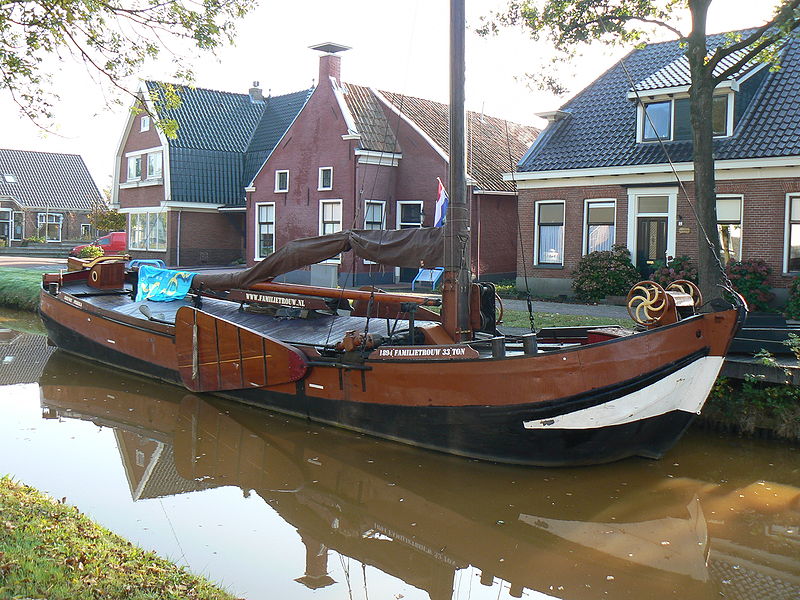
In both the towns and the landscape, there's a strictness, a radicalness if you will: the canal towns easily extend for ten, fifteen kilometres or so along the water with little of a town centre or anything. The fields themselves, black in the wintertime, are pierced by equally straight canals with water that can be grey or black in winter but a warm, dark green when the sun shines upon it.
Religiously, it's the typical countryside Dutch patchwork: my own home town sported a big Roman-Catholic Community, an equally big Dutch protestant community, and smaller Dutch-reformed, Christian-reformed and even Lutheran groups. Everywhere in the countryside, there used to be a sizable Jewish community as well until the Nazis destroyed all that. Politically, aside from places where the small Protestant parties hold sway, it's red territory: power used to be divided between Dutch labour and the Dutch communist party, and after the demise of the Dutch CP and its successor organizations the hard-left Socialist Party is making inroads. I recall that during the eighties, during election time, about half of our street would sport CP posters.
It's a wonderful place. And slowly, bit by bit, it's being fucked up beyond repair.
It's been downhill ever since deindustrialization took off in the 1960s or so, and the factories that had been so important in my home town - bricks, potato starch, but especially paper and cardboard - began to decline. Unemployment was extremely high when I grew up, and there wasn't anything (and still isn't) to keep young people in the area. No jobs. Very little in the way of entertainment: when I went out, I bicycled seventeen kilometres to Stadskanaal. There used to be a post office in the town when I was little but that's gone as well. And public transportation, connections and all that aren't getting any better either.
Can't blame them for leaving. I didn't stick around myself.
There's resentment in Groningen province towards the political elites of the West of the Netherlands. And some of it probably very justified. But the worst enemy, I think, is the layer of local politicians and bureaucrats and developers and the dreadful ideas they come up with. In the Netherlands in general, there's a harebrained idea that decent agricultural land, which our forefathers wrestled from the sea with great effort, should be "given back to nature" - as if there is such a thing as "nature" in the Netherlands. A local variety of it has been the almost-completed submerging of some of the most beautiful countryside in the area in order to build expensive (and, needless to say, pug-ugly) waterfront property - the "Blauwe Stad" project. Personally, I hope no-one will come to live there and it will turn out to be a massive financial disaster.
Though it's too late the undo the destruction that has already been wrought, of course.
Today I read that local politicians in one community have decided that the village of Ganzedijk - one of the smaller villages which has suffered especially from population drain - is to be wholly demolished. Needless to say the people remaining in the village are incensed and determined to resist (and most of them are home-owners). But it's one more symptom of the problem the countryside is dealing with. There's nothing there: the buses are replaced by taxi-buses are replaced by nothing at all; the post-office, the library, and then the schools are leaving; and finally the people themselves are packing up.
And the response by local decision-makers is to demolish or submerge the place.
It's such a waste. Not only of the beautiful, agricultural landscape, or of the unique architecture. Also of the enormous efforts that have gone in to making the country habitable in the first place. But I have little right to complain, seeing as I left like so many of my generation.
I used to think of returning sometimes. But the longer, the less I feel like it. I don't want to see the faceless suburban watery paradises that project developers are raising over what used to be farmhouses and fields. I don't want to see what they're doing to the place. It's not my home country anymore.
It's also beautiful. One of the few places in the Netherlands where you would walk or bicycle for hours on end without meeting another person. There's the scarcely inhabited no-man's land on the border where it's hard to say where the Netherlands end and Germany begins. And the spaciousness: there are very few trees, and the land is flat as can be, so there is this enormous and sometimes menacing sky hovering above you, sometimes making you feel small, sometimes comforting, in spring when everything is in bloom.
Then there's the villages. With houses that actually look like houses. Not like the deadeningly functional, characterless suburban monsters they build today, but houses with windows and door straight at the street that smile or gin or scowl at you. The way they used to build before the 1930s or so.
In both the towns and the landscape, there's a strictness, a radicalness if you will: the canal towns easily extend for ten, fifteen kilometres or so along the water with little of a town centre or anything. The fields themselves, black in the wintertime, are pierced by equally straight canals with water that can be grey or black in winter but a warm, dark green when the sun shines upon it.
Religiously, it's the typical countryside Dutch patchwork: my own home town sported a big Roman-Catholic Community, an equally big Dutch protestant community, and smaller Dutch-reformed, Christian-reformed and even Lutheran groups. Everywhere in the countryside, there used to be a sizable Jewish community as well until the Nazis destroyed all that. Politically, aside from places where the small Protestant parties hold sway, it's red territory: power used to be divided between Dutch labour and the Dutch communist party, and after the demise of the Dutch CP and its successor organizations the hard-left Socialist Party is making inroads. I recall that during the eighties, during election time, about half of our street would sport CP posters.
It's a wonderful place. And slowly, bit by bit, it's being fucked up beyond repair.
It's been downhill ever since deindustrialization took off in the 1960s or so, and the factories that had been so important in my home town - bricks, potato starch, but especially paper and cardboard - began to decline. Unemployment was extremely high when I grew up, and there wasn't anything (and still isn't) to keep young people in the area. No jobs. Very little in the way of entertainment: when I went out, I bicycled seventeen kilometres to Stadskanaal. There used to be a post office in the town when I was little but that's gone as well. And public transportation, connections and all that aren't getting any better either.
Can't blame them for leaving. I didn't stick around myself.
There's resentment in Groningen province towards the political elites of the West of the Netherlands. And some of it probably very justified. But the worst enemy, I think, is the layer of local politicians and bureaucrats and developers and the dreadful ideas they come up with. In the Netherlands in general, there's a harebrained idea that decent agricultural land, which our forefathers wrestled from the sea with great effort, should be "given back to nature" - as if there is such a thing as "nature" in the Netherlands. A local variety of it has been the almost-completed submerging of some of the most beautiful countryside in the area in order to build expensive (and, needless to say, pug-ugly) waterfront property - the "Blauwe Stad" project. Personally, I hope no-one will come to live there and it will turn out to be a massive financial disaster.
Though it's too late the undo the destruction that has already been wrought, of course.
Today I read that local politicians in one community have decided that the village of Ganzedijk - one of the smaller villages which has suffered especially from population drain - is to be wholly demolished. Needless to say the people remaining in the village are incensed and determined to resist (and most of them are home-owners). But it's one more symptom of the problem the countryside is dealing with. There's nothing there: the buses are replaced by taxi-buses are replaced by nothing at all; the post-office, the library, and then the schools are leaving; and finally the people themselves are packing up.
And the response by local decision-makers is to demolish or submerge the place.
It's such a waste. Not only of the beautiful, agricultural landscape, or of the unique architecture. Also of the enormous efforts that have gone in to making the country habitable in the first place. But I have little right to complain, seeing as I left like so many of my generation.
I used to think of returning sometimes. But the longer, the less I feel like it. I don't want to see the faceless suburban watery paradises that project developers are raising over what used to be farmhouses and fields. I don't want to see what they're doing to the place. It's not my home country anymore.
vrijdag 22 februari 2008
More on Kosovo, the muslims, etc.
Have a very ambivalent relationship to the Marxist blog Lenin's Tomb blog. Particularly as Richard Seymour is so wrong-headed about so many things - Israel, Palestine, etc. This said, he's a clearer thinker than a whole pub full of left-liberals in Euston, so to speak, and his analysis of the Kosovo issue is well worth reading.
Some of the opponents of Kosovan independence on the right see the whole issue through a muslim vs. christian prism. See Taki Theodoracopulos and John Zmirak. Now, I see their point, but the conflict remains primarily national. You want to kick out the other ethnic group so they won't ever come back, you go for their churches and their graveyards (or indeed mosques, as happened when the aggression came from the opposite direction during the Bosnian war).
There's a tendency from the US right and from European "Eurabia" ideologues such as those at the Brussels Journal and the Gates of Vienna blog to see everything through that prism: muslims are coming, having much more babies than procreation-fatigued white Christian Europeans, and if we continue, we'll all bow down in the direction of Mecca and you won't be able to get a decent piece of pork anymore in thirty years or so. To think of it, we may already be there in case of the pork. Try finding a decent bit in any restaurant or eating-stall in suburbs of Stockholm. It's all chicken or godawful Döner kebab or lamb. I want my gyros made of juicy, greasy bits of pork, not chicken. But I digress.
I don't believe that the youth that are rioting in Copenhagen in what is the last of a long series of European suburbs boiling over are motivated to any enormous extent by Islam. But what shocks me far more is the vapid, vacuous reaction from the (white, non-Muslim) political class. In the Netherlands, there has been something close to panic over a supposed short anti-Muslim film that a right-wing populist MP is reportedly making, as well as about aforementioned MP (Geert Wilders) in general, in a way that merely shows the impotence and aimlessness of the ruling coalition in the face of an Islamic threat that hasn't even materialized. In Denmark, a socialist MP has made headlines by responding to the islamist Hizb-ut-Tahrir in the following words:
Therefore let us together send them a clear message: Your benighted state of idiocy has no place on earth, because in the long run nobody wants to live in captivity, ignorance and your pathetic clumsiness (...) To those who feel attracted by HuT and who meet resistance in their life — as every human meets resistance in life: Get out of the role of victim. Get out of the Middle Ages. Have the courage to use your common sense. Acknowledge the historic superiority of democracy, acknowledge the authority and equality of women, acknowledge sensibility and knowledge as the foundation to meet other people. Then, everything is going to be all right.
Which may have given them a hard-on at Gates of Vienna but sounds like a combination of chest-thumping and hollow platitudes to me. What it does not pronounce is any serious ideological alternative to islamism. "Democracy" and "equality of women" do not amount to such a thing. Mind you, I sort of agree with the equality of women part (I'm not sure about democracy) but all of the values mentioned are merely rules of the game to make the fight between ideologies and viewpoints go smoothly. As an ideology itself, it's hollow.
And then there is the tiresome hubbub about the Danish cartoons again. Which weren't even particularly funny the first time they appeared. And, let's call the thing by it's name, racist. That does not mean their publication should have been forbidden. But, for goodness' sake, if someone publishes a crude caricature of your ethnicity's stereotypical features - complete with turban, hooked nose, bushy eyebrows, and scimitar at the ready - you have the right to take offense.
What I'm wondering is why the West's answer to somewhat-religiously motivated rioters seems to be confined to unfunny cartoons, incoherent populist politicians, egomaniacal ex-muslims, culturally semiliterate secularists, and, oh, panic panic panic? Is this how Europe should meet its own discontents? We ask our immigrant populations to assimilate - to what?
In the end, people will gravitate to something that grants them dignity. That gives them the idea that they are part of something much bigger than themselves. The thing about Western liberal secularism is precisely that it cannot do that. That it's by its very nature atomizing, individualistic, hostile to any transcendent ideals and meaning. Islam however seems to be able to do it just nicely. What are the "Eurabia" ideologues going to confront it with? Christianity? Christians are a small minority in West European countries. Nation, fatherland? But that's all been hollowed out by the EU project - and there are good reasons why precisely these concepts have been suspect in the minds of generations of Europeans. Socialism or other messianic ideologies? Dead as the druids. On the political spectrum, there are no serious alternatives to some moldy Blairite social-democrat nannyism, from Sweden to London. We're a continent without a heart.
So if those on the far right worrying about "Eurabia" are right, "Eurabia" will become a reality because Islam as a motivating ideology, as a centre of gravity, will prove to be more vibrant and forceful than anything the secular West can confront it with. And that would be that.
US embassy in Belgrade stormed
So after weeks of Western media speculation that the Serbs would "understand political realities", "forego nationalism", in other words, bend over and take it like a man, it seems that they are getting tired of being kicked around while the EU membership carrot is being dangled in front of their faces. Mark Ames at the Exile is pleased at the redecoration of the US embassy in Belgrade:
What's particularly gratifying in watching the Serbs protest and burn is that it shows the Serbs haven't been completely coapted and turned into harmless little Washington bootlickers like the rest of Europe. They have international law on their side, and they have history on their side, but the real question is whether or not they still have their souls. The protests of the past few days, and the burning of the embassy, show that they do.
I think he may be too optimistic. Serbs have often made impressive and protracted shows of defiance which turned out to be ultimately futile. I can't say I'm dismayed at the storming of the US embassy, though. After all, the US and NATO have been bombing embassies with much less reason and what's more, in countries which didn't even belong to them (for example, a Chinese one, in Belgrade). And the shocked, shocked reactions from the West at the Serbs being a tad excited over their historical heartland being snatched away from them (patriotism being very much passe over here in Europe) are rather funny. To me, anything which displeases the colourless bureaucrats and satraps of the EU, or the haughty overlords from Washington, is.
This said, I don't see any alternative but independence for Kosovo. The only way the Serbs can get it back is through enormous bloodshed and a civil war which may last forever. The Albanians own the place now, after the remaining Serbs, Roma, Jews, slavic muslims and just about anybody else left - wholly voluntarily, of course. And it's time they get to rule the place as well - they can't hardly do worse than the UN and EU have been doing so far.
Unfortunately, that would be relevant if Kosovo would actually become independent. Instead, it'll turn into another Balkans EU protectorate.
I wonder what will happen now. I don't think this is a situation that the EU and NATO are actually pleased with - my guess is that they would have preferred to have Kosovo hang in the limbo it's been in for the past ten years forever, but that delaying Kosovar self-determination would have eventually resulted in an insurrection. European states seem much more divided about recognition than was speculated at least in the Swedish media (which expected only Cyprus not to go along, and who cares about Cyprus, anyway). Russia has taken pretty high risks with regards to the Balkans before, and maybe they'll do something interesting again.
My guess is, though, that nothing will change; that the Serbs will eventually calm down in the face of some vapid promises from Brussels; and that Kosovo will remain in the limbo of de-facto independent states together with South Ossetia, Abkhazia, Transdniestria, etc. In the real world, the little guy doesn't win from the schoolyard bully. And until nations at the centre of Europe actually get tired of the EU nightmare and start reasserting themselves again, that's what's going to happen.
Abonneren op:
Posts (Atom)